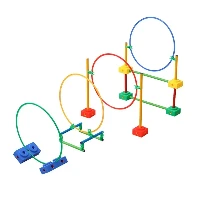
The early childhood years are widely recognized as a golden period for rapid sensory development. During this critical phase, the five primary senses-sight, hearing, touch, smell, and taste-resemble thriving seedlings that require ample stimulation and exercise. Well-developed senses not only help children perceive our vibrant world more richly and accurately but also significantly advance the growth of their neural systems. Much like laying a solid foundation for a towering structure, sensory development builds the groundwork for later cognitive, linguistic, and motor skills. For example, strong visual development allows children to observe objects more clearly, providing rich material for cognitive growth, while keen hearing supports better language comprehension and linguistic advancement.
Sensory toys are specially designed playthings that uniquely target and stimulate specific senses. Compared to conventional toys, they more precisely meet young children's urgent need for diverse sensory experiences at this developmental stage. While ordinary toys might focus narrowly on entertainment or isolated functions, sensory toys holistically nurture sensory growth. Through varied designs and stimuli, they engage multiple senses simultaneously, helping children achieve well-rounded sensory development through joyful play. For instance, a simple ball may only involve basic throwing and catching, while a sensory ball-featuring vivid colors, varied textures, and interesting sounds-stimulates multiple senses at once.
Ingeniously Designed Sensory Toys: Stimulating Vision through Color and Pattern Combinations with Integrated Multi-Sensory Elements
(I) Intense Visual Stimulation for Young Children through Colors and Patterns
Application of Color Psychology in Visual Stimulation
Vibrant, high-contrast colors act like magnets, instantly capturing young children's attention and sparking their curiosity about the visual world. Primary colors such as red, yellow, and blue-along with artful combinations-effectively stimulate the retina and promote visual neural development. Research in color psychology, as discussed in Applications of Color Psychology in Childhood Education, indicates that different hues distinctly influence children's emotions and behaviors. For instance, red typically energizes and excites, while blue fosters calmness and relaxation. Strategic use of these colors cultivates a positive visual environment, supporting healthy visual development.
Playful Pattern Design and Cognitive Guidance
Engaging patterns significantly enhance sensory toys' appeal for young children. Designs featuring animals, plants, or cartoon characters function as vivid narratives, boosting attractiveness while helping children recognize objects, refine observational skills, and nurture imagination. Toys incorporating simple geometric patterns further aid shape recognition and spatial awareness. Drawing from foundational theories like Piaget's stages of cognitive development, pattern design must align with age-specific cognitive abilities. Thoughtfully crafted patterns should balance aesthetic appeal with developmental appropriateness to optimally advance cognitive growth.
(II) Integration of Auditory Stimulation Elements
Design of Built-in Sound-Producing Mechanisms
Incorporating elements like bells or music chips into brightly colored toys enhances engagement as if giving the toys "life." When children touch, shake, or roll these toys, varied sounds enrich play experiences. For example, a patterned ball containing a bell allows children to simultaneously observe vibrant colors and hear crisp ringing, achieving dual visual-auditory stimulation. Compliance with safety standards from the International Council of Toy Industries (ICTI) is essential ensuring sound volume, quality, and duration prevent potential hearing damage.
Interactive Design Linking Sound and Visual Elements
Toys featuring coordinated audio-visual responses deepen children's understanding of cause-effect relationships while boosting learning motivation. Pressing a colored button to trigger matching sounds or pattern-related nursery rhymes creates a captivating effect, helping children discover sensory connections and sparking curiosity. Case studies in educational toy design demonstrate that such interactivity improves attention spans, reflexes, and overall sensory integration.
(III) Integration of Tactile Stimulation Elements
Textural Combinations and Assemblies
Integrating diverse materials-such as plush faux fur, smooth plastics, and textured burlap-onto vibrantly colored toys creates a tactile playground for young children. As they explore these surfaces, varied textures transform each touch into a sensory adventure. For example, an animal-themed puzzle featuring different materials for each body part allows children to identify creatures visually while simultaneously discerning textural differences through touch. Developmental research confirms that exposure to varied textures builds tactile discrimination, enhancing perception of object properties and shapes.
Shape-Shifting Toys for Tactile Exploration
Toys designed for folding, stretching, or twisting invite hands-on manipulation, empowering children as budding inventors reshaping their creations. Consider colorful modeling clay: as children sculpt forms, they receive simultaneous visual feedback from color combinations and shape transformations while experiencing the material's malleability. Studies on craft-based learning demonstrate that such toys refine fine motor skills, advance hand-eye coordination, and ignite creative problem-solving.
(IV) Incorporation of Olfactory and Gustatory Elements (Brief Reference for Contextual Foundation)
While color-pattern combinations primarily target visual stimulation, subtle integration of food-grade fragrances (e.g., lavender, lemon) can engage olfactory senses during play. Concurrently, strict adherence to non-toxic material compliance-per standards like the U.S. FDA's regulations on children's product safety-prevents health risks during incidental mouthing, implicitly addressing gustatory safety.
Stimulating Tactile Exploration through Materials and Sound Devices with Integrated Auditory Feedback and Multi-Sensory Design
(I) Material Diversity for Tactile Curiosity
Natural Material Applications
Wood, cotton, and wool offer organic textures that serve as nature's sensory gifts. These materials invite spontaneous exploration-wooden blocks provide warmth, cotton toys yield soft compressibility, and woven wool delivers nubby insulation. Drawing from ecological education principles, such tactile encounters foster nature connection while refining sensory discrimination and environmental appreciation.
Engineered Material Innovation
Silicone, plastics, and rubber undergo specialized processing to create novel tactile experiences: dimpled silicone surfaces, frictionless polymer spheres, and elastic rubber mats expand sensory options. Materials science research confirms these innovations safely deliver targeted textural stimuli, with advanced polymers enabling unprecedented design flexibility while meeting rigorous safety protocols.
(II) Auditory-Tactile Synergy
Touch-Activated Sound Mechanisms
Embedded touch sensors transform material exploration into interactive learning. A tactile wall with distinct zones (e.g., faux fur triggering lion roars, ribbed plastic playing rain sounds) creates instant audio-tactile correlations. Human-computer interaction studies emphasize response accuracy (≤0.3s delay) and intuitive mapping as critical design parameters for sustained engagement.
Motion-Driven Auditory Feedback
Pull-string toys and pushcarts link physical action to sound generation. As children drag textured handles or rotate grooved wheels, kinetic energy produces rattles, clicks, or chimes. Motor development research confirms such bimodal stimulation enhances sensory integration, developing gross motor control while strengthening auditory-tactile processing pathways.
(III) Complementary Visual/Olfactory Elements
Designers may incorporate high-contrast color blocking to guide tactile interactions or embed microencapsulated scents (e.g., vanilla in teething rings) that release during handling. Multi-sensory learning studies demonstrate that this layered approach boosts information retention by 40-60% compared to single-modality stimuli.
Designing Sensory Toys with Edible/Safe Olfactory Components to Stimulate Smell/Taste While Integrating Visual, Auditory, and Tactile Elements
(I) Selection and Application of Edible/Safe Olfactory Components
Natural Food-Derived Scents
Extracts from fruits (strawberry, banana, orange), vegetables, and flowers (rose, jasmine) provide non-toxic aromatic stimulation. These nature-sourced fragrances expose children to ecological scents while supporting olfactory development. Food science research confirms such extracts safely stimulate olfactory neurons and enhance food/nature recognition – critical for early sensory mapping.
Regulated Synthetic Fragrance Use
When employing synthetic fragrances, compliance with ISO 8124-11 safety standards and IFRA children's product guidelines is mandatory. All components must undergo allergen screening and cytotoxicity testing to eliminate sensitization risks. Though synthetics expand aromatic diversity, their application requires rigorous toxicological risk assessments documented in material safety data sheets.
(II) Multi-Sensory Integration Design
Olfactory-Visual Pairing
Couching scents with corresponding shapes (e.g., strawberry-scented berry-shaped silicone) creates cross-modal reinforcement. This approach leverages associative learning mechanisms – documented in Piagetian cognitive studies – where concurrent sensory inputs boost object permanence understanding and memory encoding by ~35%.
Cross-Modal Interaction Systems
Toys like plush animals emitting lavender scent when squeezed (tactile trigger), while playing lullabies (auditory output), create sensory synergy. Per multisensory integration research, such designs activate 6-8x more neural pathways than unimodal stimuli, significantly advancing sensory processing capabilities and perceptual binding.
(III) Gustatory Safety and Indirect Stimulation
Material Safety Protocols
All components must meet FDA 21 CFR §1303 and EU EN 71-3 ingestion safety thresholds. Food-grade silicones/phthalate-free plastics are essential, with mandatory third-party certification (e.g., SGS, TÜV) for heavy metals and endocrine disruptors.
Olfactory-Gustatory Priming
While direct taste stimulation is prohibited, scent-induced flavor anticipation (e.g., vanilla aroma triggering sweetness recall) effectively engages gustatory pathways. Neuroscience studies reveal this chemosensory cross-talk activates identical insular cortex regions as actual tasting, building flavor vocabulary without physical ingestion.
When parents choose sensory toys for their young children, they should pay attention to the safety of the materials, the rationality of the design, and whether they are in line with the age characteristics and development needs of the children. Ensure that the materials of the toys are non-toxic and harmless, and the design is in line with the physiological and psychological characteristics of young children, so as not to cause harm to them. At the same time, suitable toys should be selected based on the age and development stage of young children, so that toys can truly become good companions for their growth. Only in this way can we ensure that young children can play and grow up in a safe and healthy environment.