

Hey there! As a balance board supplier, I often get asked if a balance board can be used for balance testing. Well, the short answer is yes! But let's dive deeper into this topic and explore how balance boards can serve as effective tools for balance assessment.
First off, what exactly is balance testing? Balance testing is a way to evaluate a person's ability to maintain stability and control over their body position. It's crucial for various reasons, like diagnosing balance disorders, assessing the risk of falls, and even tracking progress in rehabilitation programs.
Now, let's talk about how balance boards come into play. A balance board is a simple yet powerful device that typically consists of a flat board placed on a rounded or unstable base. When you stand on it, your body has to constantly adjust and make micro - movements to stay balanced. This natural instability is what makes balance boards so great for testing balance.
One of the key advantages of using a balance board for balance testing is its ability to mimic real - life situations. In our daily lives, we're constantly encountering uneven surfaces, sudden movements, and changes in our environment. A balance board recreates this sense of instability, allowing us to test how well our bodies can adapt. For example, when you step on a Versatile Rocking Balance Boards, your body immediately has to engage its core muscles, leg muscles, and the vestibular system (the part of your inner ear that helps with balance) to keep you upright.
There are different types of balance tests that can be conducted using a balance board. One common test is the static balance test. In this test, the person stands still on the balance board for a set period, say 30 seconds or a minute. During this time, you can observe how well they can maintain their center of gravity over the board. Any excessive swaying, tilting, or loss of balance indicates that there might be some issues with their balance control.

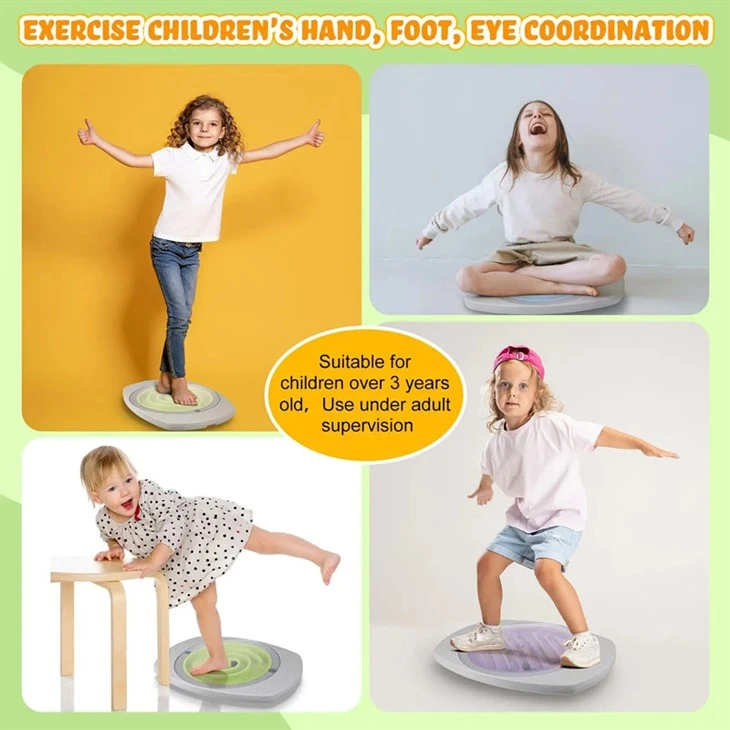
Another type of test is the dynamic balance test. This involves performing specific movements on the balance board, such as shifting your weight from one side to the other, stepping forward or backward, or even doing small jumps. Dynamic balance tests are more challenging as they require both balance and coordination. For instance, a Wobble Board for Toddlers can be used to test the early development of balance and coordination in young children. By having them perform simple movements on the board, parents and pediatricians can get an idea of how well their balance skills are progressing.
Balance boards are also great for testing balance in different age groups. For kids, balance testing is essential for their physical development. A Kids Balance Board can help identify any early signs of balance problems, which can then be addressed through targeted exercises. In adults, balance testing can be used to monitor the effects of aging on balance. As we get older, our balance tends to decline, and using a balance board can help detect these changes early on.
In addition to testing balance, balance boards can also be used for balance training. Once you've identified the areas where a person needs improvement, you can design a training program using the balance board. For example, if someone has difficulty maintaining balance on one leg, you can have them practice standing on the balance board on one leg for short periods and gradually increase the duration as their balance improves.
However, it's important to note that while balance boards are a valuable tool for balance testing, they should not be the only method used. Professional medical assessments, such as those conducted by physical therapists or otolaryngologists, are still necessary for a comprehensive evaluation of balance. Balance boards can be used as a preliminary screening tool or as a way to monitor progress during rehabilitation.
When it comes to using balance boards for testing, safety is paramount. Make sure the person using the board is wearing appropriate footwear and has a clear, stable area to stand on. It's also a good idea to have someone nearby to assist in case of a fall.
In conclusion, balance boards can definitely be used for balance testing. They offer a practical, cost - effective, and fun way to assess a person's balance abilities. Whether you're a parent concerned about your child's development, an athlete looking to improve your performance, or someone recovering from an injury, a balance board can be a valuable addition to your toolkit.
If you're interested in purchasing balance boards for balance testing or training purposes, we're here to help. We offer a wide range of high - quality balance boards suitable for different age groups and needs. Whether you're a school, a rehabilitation center, or an individual looking for a personal balance board, we've got you covered. Reach out to us for more information and to start a procurement discussion. We're excited to work with you to find the perfect balance board solutions for your requirements.
References
- Keshner, E. A., & Woollacott, M. H. (1994). Postural control in the elderly: A comparison of two balance assessment systems. Journal of Gerontology, 49(6), M220 - M227.
- Shumway - Cook, A., & Woollacott, M. (2017). Motor control: Translating research into clinical practice. Lippincott Williams & Wilkins.