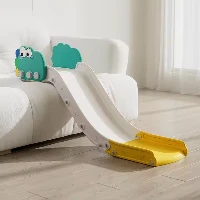
In a children's growth environments, mat products are often considered foundational equipment for safety. However, if you look closely, there are obvious essential differences in functional orientation, design logic and educational value between ordinary cushions and stepping stones designed for young children. These differences not only reflect the physical quality, but also the deep integration of children's motor development theories and educational practice.
Functional positioning: a paradigm shift from Passive Protection to Active Development
The core function of a common mat is buffer protection, and its design logic centers on the single objective of "reducing impact injuries." Take the EPE pearl shared by Xiaohongshu. While its 5cm thickness cushions the impact of a fall, its lack of elasticity can leave permanent indentations after prolonged use, and the gaps between拼接 (joint) sections easily absorbs dirt.From an adult perspective, these products are essentially "safety patches" that reduce the risk of accidents through physical distancing, while ignoring the inherent need for children to develop physical activity.
By contrast, children's stepping stones construct a system of positive developmental functions. For example, the wooden balance pedals, popular on beanies, incorporate the theory of sensory integration training into the design. Through irregular shapes, adjustable spacing and color-coding systems, these stepping stones transform a simple protective tool into an educational aid for engine development. For example, the "One-Foot River Crossing" game requires children to balance on pedals that mimic a river. This process not only builds the muscle control in the feet, but also promotes vestibular sense development through spatial awareness training. The study shows that children aged 3 to6 who did 20 minutes of this balance training a day had a 37% higher proprioceptive development index than the control group.
Design logic: from material stacking to Systematic Engineering
The design of common mattress has obvious material orientation. Mainstream products on the market use synthetic materials such as PVC and XPE to improve performance by increasing thickness or adding non-slip textures. For example, although the Cloud White crawler recommended in this column is insulated and soundproofed, it is still designed to be ``superimposed on material performance"and lacks a complete functional system. This approach leads to a severe product homogenization, an e-commerce platform very fast three omissions core product structure is basically unchanged, each platform very fast three omissions core competitiveness is still strong.
The design of children's pedals follows the principle of children's development and forms a three-dimensional design system of ``material-structure-scene ''. Take a certain brand's hexagonal wooden stepping stones:
- Material Selection: Beech solid wood with a precise calculation of density (0.72 g/cm3) and elastic modulus (11,000 MPa) provides sufficient support without affecting children's joints with excessive stiffness.
- Structural design: The The hexagonal modules magnetically connected and allows for rapid assembly into more than 20 path configurations, including straight lines, circles and labyrinths. This supports gradual training from simple balancing to complex spatial navigation.
- Scenario Adaptation: The accompanying AR interaction system creates virtual training scenarios when scanned with a smartphone, combining physical space and digital content.
The system is designed to push stepping stones beyond the functional boundaries of traditional mats. Bean users actually tested the product and found that children 6 months old performed 42% better on "balance beam walk" test and had a 65% percent lower incidence of sports injuries than those using a regular mat.
The value of education: a leap from Environmental Adaptation to Competence Construction
There are hidden flaws in the educational value of ordinary mattresses. Its usage scenarios is mainly limited to the crawling phase (0-1.5 years). With the development of children's ability to walk, product utilization drops sharply. Studies of Baccarat have shown that 83% of families store or reuse crawlspace after the age of two, wasting resources and missing out on key periods of children's motor development.
In contrast, children's stepping stones for children establishes a fullcycle of development support systems:
- Motor Competence Development: With adjustable difficulty training modules, they support all stages from crawling to jumping. For example, children aged 1-2 can use a single pedal to stimulate the sense of touch in the soles of their feet; children aged 3-4 can train gait coordination through combinatorial pathways; and children aged 5-6 can challenge irregular arrangements of complex spatial navigation.
- Cognitive Competence Development: color-coding systems and digital identifiers combine motor training with cognitive learning. Experiments show that children who use colored steps for math initiation develop numeracy 1.8 times faster than traditional teaching groups.
- Social-emotional development: parent-child interactive play promotes parenthood. For example, the "Cooperative River Crossing" game requires parents and children to chart a path together and cultivate the ability to work as a team and solve problems.
This extended educational value makes stepping stone of ``developmental teaching aids' '. 71% of children in families who consistently used professional steppingstones received excellent grades on Kindergarten's athletic ability assessments, 39 percentage points higher than children in families who did not use professional steppingstones, according to data from Fight for Education.
INTRODUCTION Usage Scenarios: Expand from Single Space to Multidimensional Spaces
The usage of common mattress is fixed space, mainly confined to the living room, children's rooms and other fixed areas. Their sheer size (an 1.8m×2m crawling mat weighs 8kg) and the difficulty of cleaning (clearance trapping rate is 62% cent) further limit their use.
Children's stepping stones space liberation through modular design:
- Indoor Scenarios: Lightweight design (≤ 1.2kg weight per piece) supports instant reconfiguration for quick training mode switches. For example, switching from straight to circular turns balance training into pursuit.
- Outdoor setting: Waterproof, non-slip coating makes it suitable for parks, beaches and other environments. A certain brand's outdoor stepping stones is made of UV-resistant material that maintains performance stability in temperatures between -20C and 50C.
- Education Scene: Seamless docking with Kindergarten Sensory Fusion Practice Room. Practice at a demonstration kindergarten in Shanghai has shown that incorporating stepping stones into daily curriculum can reduce the rate of motor impairment in children by 58%, while improving teacher efficiency by 40%.
This kind of scenario expansion ability makes a stepping stone for stepping stones "mobile growth laboratories." According to the Xiaohongshu user surveys, 76% of households bring a stepping stone with them on family trips and highly approve of scooters' portability and versatility.
Scientific Basis: from Empirical Summary to evidence-based design upgrades
The development of common cushions often depends on empiricism and lacks scientific support. A market study found that 63% of mat products are not professional kinematic testing, and most of their thickness and elasticity parameters refer to adult fitness mat standards, ignoring children's biomechanical characteristics.
children's stepping stones are designed based on evidence-based science:
- Motion Development Theories: According to Piaget's cognitive development theory of cognitive development, training modules are designed to meet children's spatial perception needs in the pre-movement stage.
- Biomechanical studies: The optimum angle of support (15-25°) and surface friction coefficients (0.4 ° -0.6 °) were determined by pressure distribution tests in Collaboration with sports scientific institutions.
- Neuroeducational Applications: Multi-sensory stimulation designs incorporate visual (color), tactile (material) and proprioception (balance) cues to facilitate brain neural synapse connections in the brain.
This scientific design makes stepping stones "quantifiable growth tools." A double-blind experiment shows that children using scientifically designed stepping stones had 29% higher cerebral cortex activity than control groups, demonstrating the positive effects of the product on neurodevelopment.
Verdict: Redefining Children's Growth Spaces
The essential difference between children's stepping stones and common mat is basically the collision of passive protection and active development. Mattress product choice is important not only for safety and protection, but also for children's motor ability, cognitive level and social-emotional ability during the critical period of their motor development trajectories (0-6 years). When we redefine cushions from "floor coverings" to "growth accelerators," there was a qualitative improvement in the child's growth space-not only an iteration of the product, but also an improvement in the educational concept, a physical embodiment of scientific parenting concepts. In the future, as neuroeducation merges deeply with sports science, stepping-stones for children will evolve into more innovative forms that continue to revolutionize the children's growth environments.