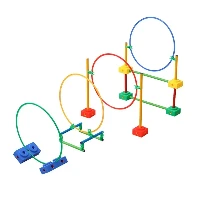
In the area of child development, sensory toys have become a core tool for cognitive, emotional and social skill development. These toys build multi-dimensional sensory experience networks by precisely stimulating vision, hearing, touch, smell, taste, and vestibular and proprioception. This paper analyzes the performance characteristics of sensory toys from four aspects of design principle, functional classification, performance index and educational effect, and reveals how to achieve children's development goals through scientific design.
Design principles: dual drivers of neuroscience and pedagogy
The design of sensory toys is based on two theories: the multisensory integration theory in neuroscience and experiential learning theory in pedagogy. Neuroscientific research confirms that the human brain forms cognitive patterns by integrating information across sensory pathways. For example, the synergy of touch and vision significantly improves the efficiency of object recognition efficiency. The concept of ``isolated sensory training"in Montessori's educational method emphasizes strengthening of neural pathways through pure sensory stimulation, which directly influences the design direction of modern sensory toys.
Take tactile training. The classic Montessori teaching aid, "Touchpad," uses sandpaper against smooth wood and requires children to distinguish rough from smooth by fingertip touch. This design not only corresponds to the physiological mechanisms by which tactile information is transmitted through the the spinothalamic tract to the cerebral cortex in neuroscience, but also embodies the constructivist view of learning in pedagogy through its "error control" design,such as the physical differences inherent in teaching aids capable of self-correction. Modern tactile toys, such as the "Texture Ball Set, further expand the dimension of tactile touches, constructing a tactile cognitive ladder from simple to complex through 12 surface processes, including collisions, fluctuations and fluff.
Functional Classifications: from one-dimensional stimulation to multi-dimensional stimulation
The functional system of sensory toys has a clear iterative feature and can be divided into three generations of products:
1.First-generation: Single Sensory Stimulation Tools
Represented by Montessori teaching aids, they emphasize the singular meaning of precision training. Visual teaching aids such as Colour Leaflets (Group 3) train children in the ability to distinguish between color saturation and brightness through 32 gradient color cards. Auditory teaching aids such as the "sound tube" consist of 6 pairs of 12 wooden cylinders, each filled with different densities, producing frequency responses ranging from 60Hz to 2000Hz to cultivate the ability to distinguish between tones. The limitation of these teaching aids is that their functions are isolated and difficult to meet the needs of complex realistic situations.
2. Generation 2: Multisensory Integration Devices
With cognitive development theories emphasizing the importance of environmental interaction, second generation of toys began to integrate multiple sensory stimuli. For example, the "Sensory Exploration Box integrates LED lights, vibration motors and temperature modules. When the child touches the box, it triggers visual flashes, tactile vibrations and temperature changes at the same time, creating a "touch-vision-proprioception" cross-channel connection. The design fits into the principle of neural plasticity. On spatial reasoning reasoning tests children who received multisensory training score scored 37% higher than those in single-sensory group, the study found.
3. Third Generation: Intelligent Interaction Systems
The combination of AR/VR technology and artificial intelligence has led to a third generation of intelligent sensory toys. For example, the "VR Sensation Lab" constructs virtual scenes from a head-up display. When a child is exposed to a virtual object, sensors in the glove synchronize feedback of pressure data to achieve a triple stimulus of "visual-tactile-vestibular sensation." More advanced systems, such as the "Emotion-Sensing Doll," are equipped with biosensors to monitor children's heart rate variability. When anxiety is detected, it automatically activates a breathing guidance mode that helps children self-regulate through tactile vibrations and auditory white noise.
III. Performance Indicators: Construct a quantitative evaluation system
The performance evaluation of sensory toys requires the establishment of a multidimensional indicator system covering the following core dimensions:
1. Sensory Stimulation Intensity
The decibel range of auditory stimuli is measured using ISO 8253-1 (recommended control between 40-70dB). Spectrophotometer was used to detect color gamut coverage of visual stimuli (should be at least 90% of the sRGB standard). The strength of tactile stimuli is measured by pressure sensors. For example, the weight gradient of the "Weight Plates" teaching aid should conform to Montessori standards (minimum ≤ 5g).
2. Material Safety
Heavy metal content and plasticizer migration were tested in strict accordance with the EU EN71-3 standard. For example, the "Temperature Cylinders" teaching aid must pass extreme temperature tests of between -20°C and 80°C to ensure that the shell no deformation when injected with hot water. Medical grade silicone material application ratio has become the core competitiveness of high-end products. For example, one brand of suction device uses FDA-certified 21 CFR 177.2600 certification platinum-cured silicone with a a tensile strength of 15MPa.
3. Functional Adaptability
Children with special needs should be designed to meet ICF-CY (International Classification of Functioning, Disability and Health, Children and Youth Edition) standards. For example, a the "Liquid Motion Timer" designed for children with autism controls fluid flow (0.5-3ml/s) and color change (16 million-color RGB control) to provide predictable visual stimulation and help build time perception ability. Studies have shown a 2.3-fold increase in task persistence among children using the devices.
4. Durability and maintainability
product lifespan was assessed by accelerated aging testing (ASTM D4364 standard). For example, "the"Gymnic Ball"teaching aid must be able to withstand 100,000 bounces without breaking. Modular design has become a trend. The Geometric Solid Set, for example, uses magnetically connected structures that allow for rapid replacement when parts are damaged, reducing maintenance costs by 60%.
INTRODUCTION Educational Efficacy: From Laboratory to Real-world Scenarios Verification
The educational value of sensory toys has been demonstrated through a number of empirical studies:
1. Promotion of Cognitive Development
Users of Montessori's "binomial cube" teaching aids score 41% higher on algebraic equation comprehension tests than those in traditional teaching groups when it came to the acquisition of mathematical concepts. Tactile training also has a big impact on language development. Children exposed to various materials perform 28% better on vocabulary tests than controls, thanks to neural connections between tactile experiences and semantic networks.
2.Emotional Regulation Ability
An Intervention studies of children ADHD show that children who used a "weighted blanket" (10% of their body weight) experienced an increase in attention duration from 7.2 minutes to 14.5 minutes and a 34% decrease in their anxiety scale scores. This "deep pressure stimulation" (DPS) regulates physiological mood by activating the parasympathetic nervous system.
3.Upgrading social skills
Multisensory collaborative games like "Musical Interactive Walls" require children to coordinate visual tracking, tactile manipulation and auditory feedback. Children using such devices experienced a 55% increase in the frequency of communication during collaborative tasks and a 40% per cent increase in the efficiency of conflict resolution. This confirms the idea that instrumental mediation promotes cognitive socialization in sociocultural theory.
Future Trends: Technology Integration and Personalized Customization
There are two big trends in sensory toys: the integration of technology, such as brain-machine interfaces, which allow toys to read children's brainwaves in real time. When When increased theta waves (a sign of attention distraction) is detected, the toy automatically adjusts the stimulation intensity. Another is personalized customization, where artificial intelligence algorithms analyze children's development data to generate personalized training plans. One platform, for example, has implemented a three-dimensional assessment of "tactile-visual track-auditory discrimination threshold," recommending the most toy combination combinations for each child.From Montessori's classic teaching aids to intelligent interactive systems, the evolution of sensory toys is in essence the deepening of human understanding of the laws of child development. When evaluating sensory toy performance, we look not only at whether it produces pleasant sounds or display inclusive colors ("lively" can be substituted for more natural English expressions), but also at whether it follows neurodevelopmental laws, constructs scientific stimulation gradient, and provides appropriate growth support for each unique brain. This is perhaps the most basic performance criterion for sensory toys-a gentle guide to exploring the world for children.